Ingredients

What's In It (and What's Not)

Many of our customers are expert label readers. We hear you — here's exactly what goes into every bar and balm, and what we deliberately leave out.

The Never Ever List

What you'll never find in our products

The short version is below. The full list — with the why behind each one — lives on its own page.

Read the full Never Ever list →
Parabens Sulfates (SLS/SLES) Synthetic Fragrance Phthalates Synthetic Dyes Formaldehyde Releasers Mineral Oil EDTA

Goat Milk From Our Herd

Every bar and balm starts with milk from goats we know by name. We milk in a parlor that shares a wall with our Grade A dairy room — and we get to watch the goats through the window while we work.

Goat milk is closer to your skin's own pH than water-based products. It carries caprylic and capric fatty acids, lactic acid, vitamin A, and selenium — which is why our bars lather creamy and our balms feel nourishing instead of greasy.

About That Glycerin

Real soap makes its own glycerin — a natural humectant that pulls moisture toward your skin. Large manufacturers strip it out and sell it separately, then add synthetic ingredients back in to make up the difference.

We leave every drop where it belongs: in the bar. It's one of the simplest reasons handmade soap feels so different.

What's In Our Soaps & Shampoo Bars

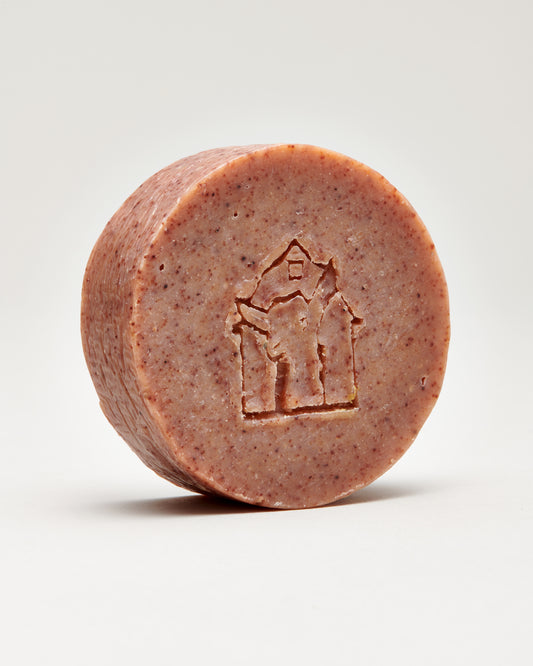
Every soap starts with whole fresh goat milk and a recipe of oils chosen for lather, conditioning, and a long-lasting bar.

Full ingredient breakdown:

Collapsible content

Milk

Goat milk — Caprae lac. From our own herd. Fresh in our soaps; pasteurized and freeze-dried into powder for our balms. Naturally moisturizing, with lactic acid as a mild exfoliant.

Oils

Olive oil — Olea europaea. Certified organic. The conditioning workhorse of our soap recipes — gentle, moisturizing, and the reason a goat milk bar feels mild instead of stripping.
Coconut oil — Cocos nucifera. Certified organic. Brings the bubbles and the cleansing power; balanced against richer oils so it never feels drying.
Hemp seed oil — Cannabis sativa. Certified organic, cold-pressed (no CBD or THC — those live in the flower, not the seed). High in linoleic acid for a silky, conditioning bar especially good for sensitive or acne-prone skin.
Neem oil (in  Working Hands soap and in our dog shampoo- )Azadirachta indica. Certified organic, cold-pressed. Naturally antimicrobial and antifungal, used in Ayurvedic skincare for thousands of years for problem skin. It’s in the pup shampoo because it is so good for tender skin- the antibug effects are incidental! Neem has an earthy smell all it’s own. Some folks like it. 
Meadowfoam seed oil — Limnanthes alba. Grown in the Willamette Valley by a farmer cooperative.  Exceptionally stable — it resists oxidation, which keeps our balms fresh for longer without preservatives. It has a lovely skin feel and carries other oils' skin-loving compounds deeper into your skin.
Daikon seed extract — Raphanus sativus. Certified organic. A light, silky emollient pressed from radish seeds; a sustainable crop grown in the Willamette valley as part of regenerative rotation .Daikon Seed Extract has been tested to show additional strength and shine in hair product, and it helps to decrease transdermal water loss. That’s why we add it to our shampoo and use it as a base oil along with meadowfoam in our balms.
Baobab oil (in our shampoo bars)Adansonia digitata. Certified organic, cold-pressed from the seeds of the African baobab tree. Rich in vitamins A, D, E, and F; conditions hair without weighing it down, especially good for curly, coarse, or coily hair.
Tamanu oil (in our shampoo bars)Calophyllum inophyllum. Certified organic. A traditional Polynesian oil prized for soothing itchy, flaky, or irritated scalps — and a long-standing folk remedy for thinning hair.

Butters & Solid Fats

Shea butter — Butyrospermum parkii. Certified organic, unrefined, from Ghana. Adds hardness and creamy lather to soap; gives balms their scoop-and-melt body. Rich in vitamin E and skin-soothing compounds.
Murumuru butter — Astrocaryum murumuru. Certified organic, Wild-harvested murumuru butter sourced from Amazon forest communities in Acre, Brazil.. . A softening, silky butter that adds a subtle gloss and slip to our balms.
Beeswax — Cera alba. Cert. organic.  Gives balms their structure and forms a gentle barrier that helps your skin hold onto its own moisture. We have our own hives for the honey in our formulations but not enough bees to be able to harvest enough bees wax. 

Lye

Sodium hydroxide (lye) fully reacted during saponification; none remains in the finished bar.Used to make solid at soap bars that are solid at room temperature. 
Potassium hydroxide (KOH) (in our dish soap and pup shampoo) — another form of lye. Reacts with oils the same way sodium hydroxide does, but produces a soft or liquid soap instead of a bar. Fully reacted during saponification; none remains in the finished product.

What's In Our Balms

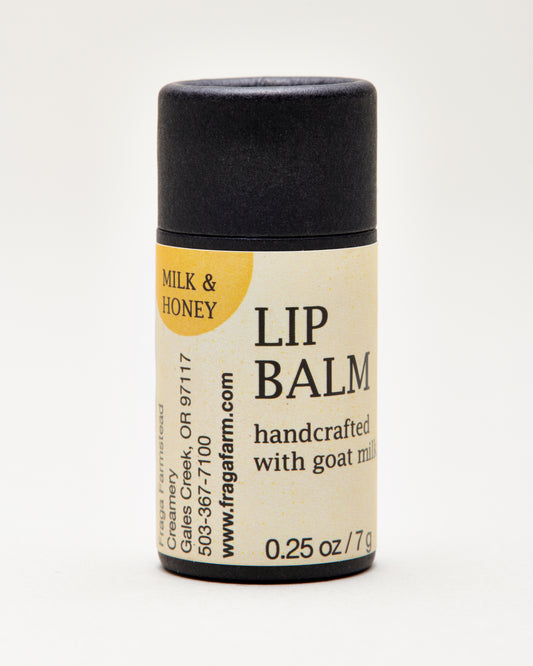
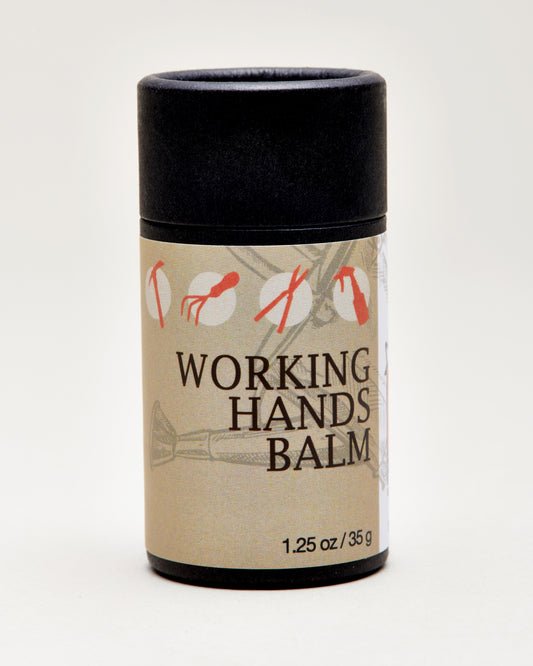
Every balm starts with our own freeze-dried goat milk powder, blended into an anhydrous formula of butters, oils, and waxes — a lotion without the water, preservatives, and emulsifiers.

Full ingredient breakdown:

Collapsible content

Milk

Goat milk powder — Caprae lac. Pasteurized and freeze-dried from our own herd, carrying the milkfats, proteins, and lactic acid into a shelf-stable balm. The reason our balms are nourishing instead of greasy.

Oils

Meadowfoam seed oil — Limnanthes alba. Grown in the Willamette Valley by a farmer cooperative. Exceptionally stable and slow to oxidize, which keeps our balms fresh without preservatives. Carries other oils' skin-loving compounds deeper into your skin. The backbone oil in every one of our balms.
Daikon seed extract — Raphanus sativus. Certified organic, grown in the Willamette Valley as part of a regenerative rotation. A light, silky emollient that helps decrease transdermal water loss — one of the reasons our balms hold moisture in your skin. It has an amazing glide and natural formulas often use it instead of silicones. 
Olive oil (in our Hard Working Hands and Paw & Snout balms)Olea europaea. Certified organic. Adds richness and a gentle, conditioning feel.
Coconut oil (in our Paw & Snout balm)Cocos nucifera. Certified organic. Adds a light protective layer on paw pads and snouts.
Hemp seed oil (in our Bug Repellent balm)Cannabis sativa. Certified organic, cold-pressed (no CBD or THC — those live in the flower, not the seed). High in linoleic acid; soothing on bug-bitten skin.
Neem oil (in our Paw & Snout balm and Working Hands soap)Azadirachta indica. Certified organic, cold-pressed. Naturally antimicrobial and antifungal — in the paw balm because it's so good for tender skin; the anti-bug effects are incidental. Neem has an earthy smell all its own. Some folks like it.
Soy Oil (in our Bug Repellent balm only) Glycine max. Certified organic, non-GMO. We don't reach for soy casually — we use it here because it's one of the few base oils registered by Health Canada as an active insect repellent, working with the essential oils to make them last longer on your skin. The base is part of the formula, not just a carrier.

Butters & Solid Fats

Shea butter — Butyrospermum parkii. Certified organic, unrefined, from Ghana. Gives our balms their scoop-and-melt body and carries vitamin E and skin-soothing compounds straight to your skin.
Cocoa butter — Theobroma cacao. Certified organic. Adds firmness and a creamy melt, with a faint natural chocolate scent that comes through in our unscented lip balms.
Murumuru butter (in our Hard Working Hands balm)Astrocaryum murumuru. Certified organic, wild-harvested from Amazon forest communities in Acre, Brazil. A softening, silky butter that adds a subtle gloss and slip.
Beeswax — Cera alba. Certified organic. Gives balms their structure and forms a gentle barrier that helps your skin hold onto its own moisture. We have our own hives for the honey we use in formulations but not enough bees to harvest beeswax ourselves — yet.
Soy oil (in our Bug Repellent balm only)Glycine max. Certified organic, non-GMO. Soy can be a controversial ingredient, and we wouldn't reach for it casually — we use it here for one specific reason: It’s superb function in a bug repellent balm. it's one of the few base oils registered by Health Canada as an active insect repellent ingredient, and it works synergistically with the essential oils in this balm to make them last longer on your skin. The base is part of the formula, not just a carrier. The bug balm is the only product we use it in. 

Botanical Extracts

Calendula (in our Hard Working Hands balm)Calendula officinalis. Certified organic. The classic skin-soothing flower; calms redness and irritation, gentle enough for sensitive skin. We infuse it into our oils ourselves.
Nettle (in our Hard Working Hands balm)Urtica dioica. Mineral-rich and conditioning, high in beta-sitosterol and silica. Wild harvested by us along a creek in our coast range. Nettle and Calendula are the two botanicals that 1. We know they work. 2. Have been used for hundreds of years in healing salves. 3. Have solid scientific studies behind them that support the “we know and and knew it” claim! 
Hibiscus (in our Rose Tint lip balm)Hibiscus sabdariffa. Lends a soft natural pink hue and a subtle floral note.
Alkanet root (in our Rose Tint lip balm)Alkanna tinctoria. A traditional rose-to-violet colorant pressed from a Mediterranean root; the warm pink in our tinted lip balm comes from here.

Essential Oils

Every balm scent is built from essential oils — no fragrance oils and no undisclosed additives. One of the essential oils- the Grand Fir oil is made by us here on the farm from our own fir trees. Essential oils are the essence of plants.

Picture an entire F150 truck loaded with branches from the woods. The yield? A quart jat under the best case scenario many many hours later. Essential oils are potent and the amounts that we use are compliant with the strict guidelines put forth by the International fragrance Association- you can’t just add “a bunch more” to get a stronger scent- it could cause sensitivity and irritation. They are also wondrous compounds.

Our Grand Fir oil has up to 80 different compounds in it. This is what makes a true Essential oil so exquisitely more complex than any fragrance oil. 

Most-used in our balms include peppermint (cooling), grand fir and cedarwood (woodsy), bergamot and lemon eucalyptus (bright/citrus), and rosemary (herbaceous and naturally antioxidant).
*The specific essential oils vary by product. Check each label for the full list.

Functional Additions

Vitamin E — tocopherol. A natural antioxidant that helps protect oils from oxidation, extending shelf life without synthetic preservatives. In every lip balm.
Shop the Collection

Small-batch, farm made